
Module 1 · PDF
Operating Manual
$59USD · one-time
- 47-page A4 PDF, designed for print and screen
- 10 parts in the order you use them
- 15 working assets, each with a five-part brief
- Worked examples on one fictional territory, end to end
The single source of truth: every rule, threshold and stop rule, written down once.
$59USD · one-time · instant download
Tax calculated at checkout · Single-user licence · How delivery works
The problem it solves
Most prospecting advice tells you what good looks like. It rarely tells you when to stop researching, what score qualifies an account, or what to do when the buying committee is unknown. Without those rules, every account is decided from scratch.
What you receive
Contents
How it works
Exclusions are checked first; required criteria are true/false. False disqualifies, unknown gets one 5-minute verification, then Hold.
A 15-minute, three-pass time box: a 3-minute gate, 7 minutes for triggers and pain, 5 minutes for fit and value. One 5-minute extension per account.
Company primary sources, reputable secondary, data provider, inference. A Tier 4 inference is a hypothesis and supports a score of 1 at most.
Fit, Timing, Pain, Buying potential and Strategic value, each 0–3. Qualified when Total ≥ 9 and Timing ≥ 2.
Value (Fit + Buying potential + Strategic) and Urgency (Timing + Pain) set P1, P2 value-led or P2 timing-led.
Six touches over 15 working days, each with a channel and a job — from “open with the trigger” to “close the loop”.
Product previews
Pages rendered directly from the PDF you download. Select any preview to enlarge it.
How to use it
Read Parts 01–02 for the model (about 25 minutes).
Work through Parts 03–09 with your own territory open beside you. Each ends in a decision you can act on the same day.
Use Part 10 to set your weekly rhythm, then keep the Quick Reference (p.40) next to you.
How it connects
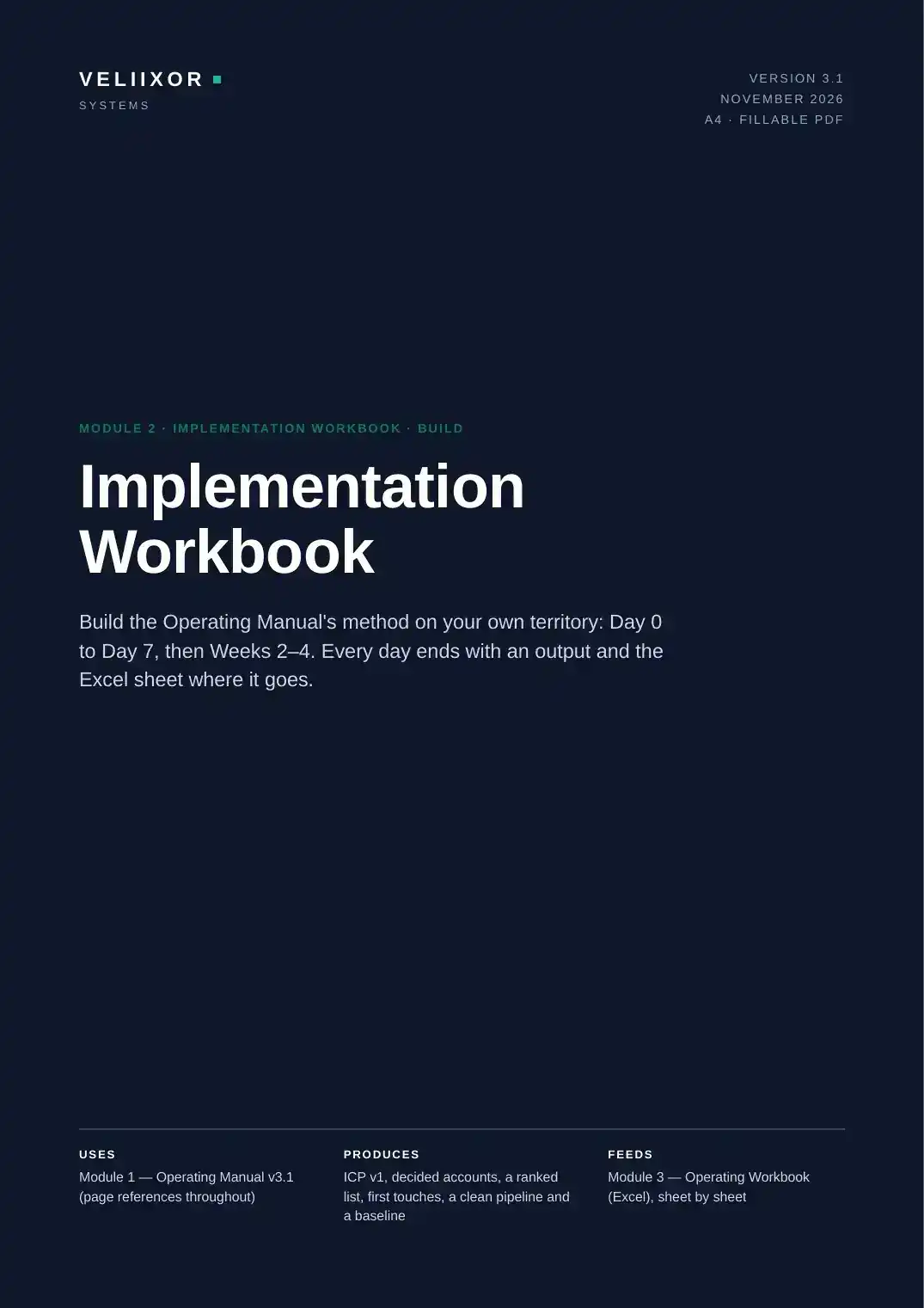
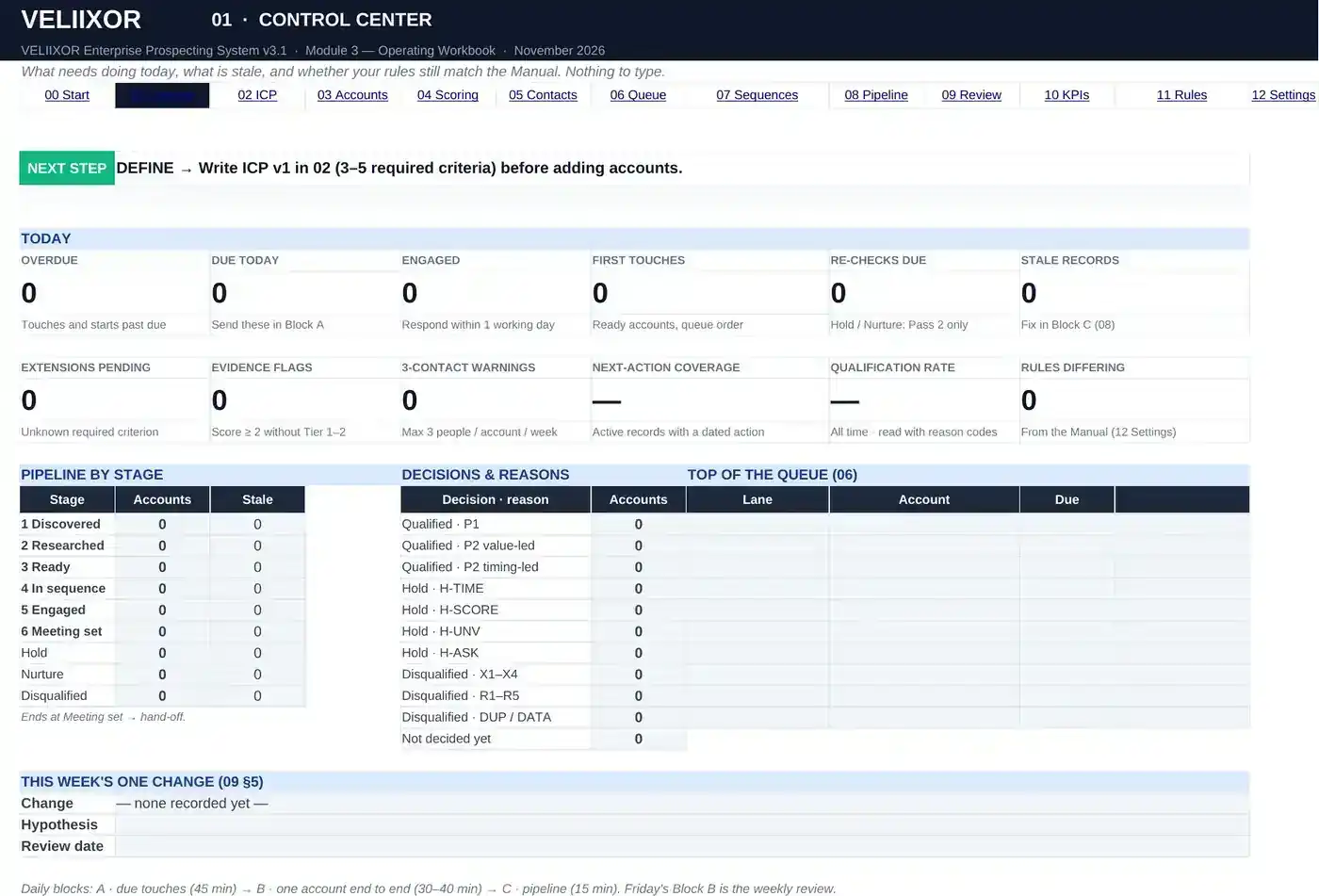
Module 2 applies these rules to your territory day by day. Module 3 enforces Parts 03–09 in Excel. Both point back to the Manual’s page numbers instead of restating it.
Pricing
Module 1 · PDF
$59USD · one-time
Modules 1 + 2 + 3
$129USD · one-time
$38 less than buying the three modules separately ($167).
Prices in USD. Sales tax or VAT is calculated at checkout by Lemon Squeezy, the merchant of record. Single-user licence · Refund Policy
Yes. It states that it is self-contained: every rule is explained there, and the six printable templates in the appendix let you apply it without the other modules.
No. Every company, person and number in the worked examples is fictional, and the Manual says so. Example numbers show how to read data; they are not benchmarks or customer results.
The method is industry-neutral. The running example is a fictional procurement-software seller targeting multi-site manufacturing, distribution and logistics companies in North America, the UK and the EU.
It includes a Trigger-to-Message Framework, personalization rules, a worked first email and connection note, and a sequence planner. It teaches you to write from evidence rather than giving a swipe file.
Or get all three modules and run the full system from Day 0.
Preview build
This button opens the secure Lemon Squeezy checkout once the store is live. Nothing has been charged and no order exists.